
Road safety remains one of the most critical challenges in modern urban infrastructure. With increasing vehicular density and rapid urbanization, the condition of road surfaces directly impacts public safety, economic productivity, and quality of life. Potholes, cracks, water logging, and other surface defects contribute significantly to road accidents, vehicle damage, and traffic congestion. Traditional methods of road inspection, relying primarily on manual surveys and citizen complaints, have proven to be time-consuming, inconsistent, and often ineffective in addressing these issues promptly.
The emergence of Internet of Things (IoT) technology, embedded systems, robotics, and web-based platforms has opened new avenues for intelligent infrastructure monitoring. These technologies enable real-time data collection, automated analysis, and centralized management of road conditions, offering a transformative approach to road safety management. By leveraging these advancements, it becomes possible to create systems that not only detect and report road hazards efficiently but also verify and validate them through automated mechanisms.
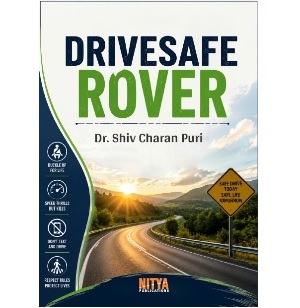
This book, DriveSafe Rover: An IoT-Based Smart Road Safety Monitoring System, documents the complete development journey of our final year B.Tech project. The DriveSafe Rover represents an innovative integration of crowd-sourced reporting, robotic verification, and web-based monitoring into a unified platform for intelligent road safety management. The system allows public users to report road hazards through a user-friendly web interface, after which an IoT-enabled robotic rover is deployed to physically verify the reported conditions using real-time video streaming and sensor-based measurements.
The primary objective of this book is to provide a comprehensive technical documentation of the DriveSafe Rover project, covering all aspects from conceptualization and literature review to hardware design, software development, system integration, and performance evaluation. The content is structured to serve as both a project report and a reference guide for students, researchers, and practitioners interested in IoT-based robotic systems for smart infrastructure applications.
The book has been organized to give total overview of the content addressing introduction to road safety challenges , literature review of existing road monitoring technologies. the overall system architecture and functional workflow, hardware components and circuit design, software architecture and web interface design, operational algorithm and working principles and results and performance analysis along with the discussion of the advantages, applications, limitations, and future scope of the system.
I express my sincere gratitude to Asansol Engineering College for providing the academic environment and support necessary for this work. I would also like to convey my heartfelt thanks to Prof. (Dr.) Arup Kumar Bhaumik Principal Asansol Engineering College, Dr. Debashis Sarkar, Registrar Asansol Engineering College , and Dr. ChiranjIb Goswami, Head of the Department of Electronics and Communication Engineering Asansol Engineering College for their valuable guidance and encouragement. Special acknowledgment is extended to Aqdas Sultan, Faiz Hussain , Apoorva Pandit and Abhishek Ranjan for their immense help and support during the preparation of this book.
Dr. Shiv Charan Puri
Asansol Engineering College
May 2025
Nitya Publications, Bhopal MP, India is a fast growing publisher and serving at national and international level. We are publishing all type of books like educational books, seminar / conference proceeding, reports, thesis, story books, novels, poetry books and biographies etc with ISBN.
Nitya Publications, Bhopal MP, India is a fast growing publisher and serving at national and international level. We are publishing all type of books like educational books, seminar / conference proceeding, reports, thesis, story books, novels, poetry books and biographies etc with ISBN.
Built with ❤️ in India | nityapublications Copyright 2023 All Rights Reserved .
