
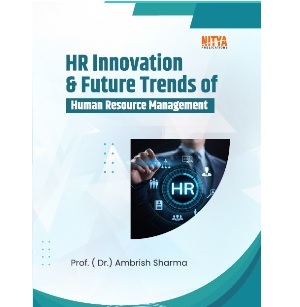
Preface
In this rapid technological advancements, shifting societal expectations, with pace of global change, the field of Human Resource Management (HRM) is undergoing a profound transformation. What was once perceived merely as a functional, administrative role, has now evolved into a strategic pillar integral to the agility, resilience, and innovation capacity of modern organizations. HR has stepped beyond the confines of traditional hierarchical structures to emerge as a catalyst for building inclusive cultures, nurturing talent, ensuring holistic employee well-being, and guiding organizations through the complexities of digital disruption and economic volatility.
HR Innovation and Future Trends of HRM has been meticulously curated to serve as a definitive guide for students, scholars, HR practitioners, and business leaders alike who are committed to understanding and shaping the evolving landscape of work. Whether you are an aspiring student eager to explore the multifaceted dimensions of HR, a researcher analyzing organizational behaviour, an HR professional seeking practical strategies to stay ahead, or a leader striving to future-proof your organization, this book offers a structured pathway to navigate the complexities and opportunities emerging in HR’s dynamic ecosystem.
This work reflects an integrated perspective that blends rigorous academic insights with corporate applications, ensuring that each concept is both intellectually and practically actionable. The intention is to empower HR leaders and learners to become proactive architects, equipped with the vision and tools necessary to guide organizations through continuous transformation.
Among the key themes explored is organizational agility and workforce flexibility, emphasizing the rising importance of adaptable structures, hybrid work models, and cross-functional collaboration in maintaining a competitive edge. In a world where the gig economy is reshaping traditional employment models, HR leaders are tasked with crafting policies that balance organizational goals with employee aspirations, flexibility, and well-being. A significant portion of this book is dedicated to Diversity, Equity, and Inclusion (DEI), underscoring that genuine inclusion goes beyond compliance checklists to become a source of profound innovation and resilience.
Equally vital is the focus on employee well-being and mental health, now recognized not merely as a corporate social responsibility but as a foundational element for sustainable productivity and organizational health. In today’s work environment, where burnout and mental fatigue are prevalent, HR professionals must prioritize the development of supportive structures and policies that enable employees to thrive personally and professionally.
The emergence of data-driven HR practices is another pivotal theme, marking a shift from intuition-based decisions to evidence-backed strategies. Through analytics, HR leaders can uncover deep insights into workforce dynamics, enabling more accurate forecasting, improved talent management, and better alignment of HR initiatives with overarching business objectives.
To prepare for the demands of an uncertain future, future-ready skill development and continuous learning ecosystems are also explored in detail. As technological advancements redefine job roles and required competencies, organizations must foster a culture of lifelong learning to enable employees to adapt, grow, and lead amidst constant change.
Additionally, the book delves into the strategic role of employee experience and organizational branding, exploring how fostering meaningful connections and purpose within the workplace can significantly enhance employee engagement, retention, and productivity. Ethical leadership remains a central pillar in navigating the digital age, with dedicated chapters exploring algorithmic bias, employee surveillance, and data privacy. These discussions emphasize the necessity for transparency, accountability, and integrity in HR practices as digital tools and artificial intelligence become deeply integrated into HR operations.
As remote and hybrid work models transition from temporary solutions to enduring structures, HR leaders must develop competencies in managing distributed teams, ensuring collaboration, maintaining performance standards, and building cohesive cultures across virtual spaces. Practical strategies offered within this book aim to assist organizations in creating environments where remote work enhances productivity without compromising employee well-being.
The evolving role of HR in corporate social responsibility (CSR) and environmental, social, and governance (ESG) goals is also explored in depth. As businesses are increasingly held accountable for their societal and environmental impacts, HR’s role in aligning people strategies with broader sustainability goals is critical to advancing the organization’s social license to operate while cultivating a workforce that is conscious of its collective responsibility.
The concluding sections of this book focus on the future of recruitment and talent acquisition, spotlighting transformative trends such as predictive analytics, gamified assessments, and inclusive hiring practices designed to broaden talent pipelines and promote equity. As organizations seek to attract, engage, and retain the best talent, adopting these innovative practices will be crucial in maintaining competitiveness and ensuring alignment with organizational values.
This book, HR Innovation and Future Trends of HRM, is my humble contribution to the ongoing global dialogue on the future trajectory of HR. It has been written with the intention of providing clarity, inspiration, and practical guidance to all who are committed to fostering ethical, inclusive, adaptive, and people-first organizations in a world characterized by constant flux and complexity.
I sincerely hope this work empowers you—whether you are a student preparing to enter the HR field, a practitioner refining your approach, or a leader crafting a forward-looking strategy—to actively participate in shaping a future of work that is not only technologically advanced and agile but also deeply human-centered and values-driven.
In a rapidly evolving landscape, the role of HR has never been more critical. Let us embrace this transformation with curiosity, courage, and commitment to build organizations that prioritize people, purpose, and progress in equal measure.
Prof. (Dr.) Ambrish Sharma
Nitya Publications, Bhopal MP, India is a fast growing publisher and serving at national and international level. We are publishing all type of books like educational books, seminar / conference proceeding, reports, thesis, story books, novels, poetry books and biographies etc with ISBN.
Nitya Publications, Bhopal MP, India is a fast growing publisher and serving at national and international level. We are publishing all type of books like educational books, seminar / conference proceeding, reports, thesis, story books, novels, poetry books and biographies etc with ISBN.
Built with ❤️ in India | nityapublications Copyright 2023 All Rights Reserved .
